About Palo Alto Clinic (Roth Building) Frescoes
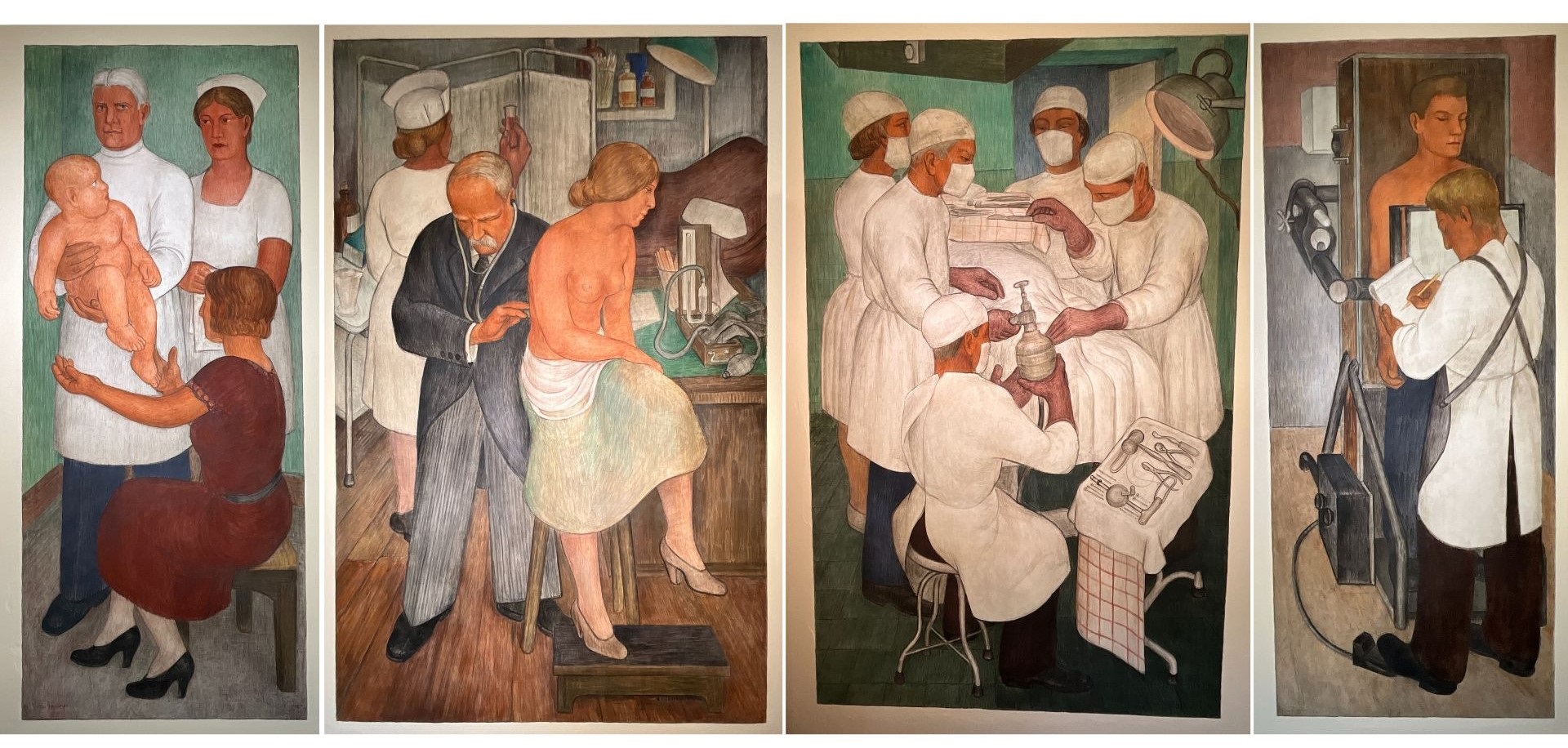
Modern and Ancient Medicine by artist Victor Arnautoff, located at the entrance to the Palo Alto Museum (former Palo Alto Clinic), is a series of buon frescoes consisting of four vertical color panels, paired with nine smaller black and white (grisaille) panels, and four sepia medallions. The mural illustrates early-twentieth century modern medicine in contrast with historic medical practices. Commissioned by Dr. Russell Lee in 1931 and completed by the artist in 1932 the frescoes were Arnautoff’s first private commission in the United States upon his return from Mexico where he had worked with Diego Rivera painting frescoes at the Palace of Cortés in Cuernavaca, Mexico.
The mural composition and subject matter emphasized the advancement of modern medicine and technology for the newly opened medical facility and depicted its focus on a broad range of medical care that was available at the Palo Alto Clinic, including pediatrics, internal medicine, surgery, and x-ray technology. The sepia medallions are on the arches leading to the loggia and portray Lister, Hippocrates, Pasteur and Roentgen.
Restoration and Preservation of Arnautoff's Frescoes
 Originally painted in 1932, very little had been known about the frescoes' physical condition and any past repairs or restoration treatments. Despite the high-quality plaster and pigments used by the artist, public use and frequent cleaning from the 1930s to the 1980s have significantly contributed to its deterioration, especially in the lower grisaille panels.
In early 2000s, the City of Palo Alto purchased the Roth building. In 2016, the Public Art Commission formally accessioned the historic frescoes, allowing the City's Public Art Program staff to provide essential maintenance, protection, and conservation for this unique and significant artwork. A detailed condition assessment by fine art conservators stated a need for further analysis and extensive restoration of the precious ninety year old fresco mural. To coincide with the comprehensive re-habilitation of the historic building, the City of Palo Alto Public Art Program engaged an experienced fine art conservators and experts on Diego Rivera and Victor Arnautoff frescoes, Anne Rosenthal and Kiernan Graves, to perform an extensive study, cleaning, and restoration project of the frescoes. This complex project, launched in 2023 and partially funded by Santa Clara County’s Historic Grant Program grant, has accomplished full restoration of the four large color frescoes, and complete in-depth cleaning and treatment examination of the lower grisaille panels and sepia medallions. As a result of this restoration project, the four large color panels were completely restored and today look as they did in the summer of 1932! In-depth analysis and off-site lab tests (in the US and Italy) provided further insight into the complex condition of the lower panel frescoes, that will be the focus of the next restoration campaign in the near future.
Images above: Victor Arnautoff’s four fresco panels — Pediatric Care, Internal Medicine, Neurosurgery, and Fluoroscopic Examination (left to right) — detail of the Modern and Ancient Medicine fresco mural, painted in 1932 and restored in 2024.
Images below, left to right: detailed views of Internal Medicine and Neurosurgery fresco panels before and after conservation treatment in summer 2024. Image in the middle: fine art conservator Kiernan Graves inpainting the fresco area after it was cleaned of pollution, foreign materials, and previous restoration paints. Image courtesy of Anne Rosenthal Fine Art Conservation.

About the Artist
Born in Mariupol in Russian Empire (modern Ukraine), Victor Arnautoff (1899-1979) was a highly decorated cavalry officer serving in the white army of Nicholas II until he was forced to flee to Manchuria, China after the Bolshevik Revolution. He came to San Francisco in the early 1920 to fulfil his dream of pursuing art education. A talented art student, Arnautoff was given an opportunity to go to Mexico where he studied fresco painting under Diego Rivera, soon becoming his trusted assistant. During the years spent in Mexico with Rivera, Arnautoff mastered the artistry of fresco painting, and acquired in-depth knowledge of the plaster and material preparation which enabled him to supervise, guide, and effectively work with craftsmen plasters.
By 1931, both Rivera and Arnautoff were in San Francisco working on a mural commissioned by the San Francisco Art Institute. In 1932, Dr. Russell V. Lee hired Arnautoff to paint a mural surrounding the entry of the newly built Palo Alto Clinic. The commissioned mural was to illustrate the medical history, its most notorious historic figures, and to celebrate the innovations and progressive practices in the world of medicine as a reflection of values of the brand-new clinic. In the summer of 1932, the Modern and Ancient Medicine fresco was created by the artist.
Arnautoff's experience with Rivera and the public attention he received for his Palo Alto Clinic frescoes led to his appointment as technical coordinator for the twenty-five artists who began work that December at Coit Tower in San Francisco, to supervise a team of 24 artists painting frescoes for the iconic building interior. Arnautoff's monumental fresco mural titled City Life, is a spectacular work of art that received national attention. This was the very first project of the Public Works of Art Project (PWAP), a New Deal program, designed to employ artists during the Great Depression to create art for public buildings and parks, operating from 1933 to 1934. Other US commissions by Arnautoff included murals for the Presidio Chapel, George Washington High School, several post offices and at the California School of Fine Arts.
What is a Fresco?
A fresco is a type of mural painting where pigments are applied onto freshly laid wet plaster. The color becomes a permanent part of the wall as it dries, making the painting highly durable.
Fresco painting dates back to ancient times, with early examples found in Minoan, Egyptian, and Roman art. With the revived interest to the Greco-Roman culture and art during the Italian Renaissance (14th–16th centuries), the technique flourished with masters like Giotto, Michelangelo, and Raphael creating iconic works. Among the most famous examples are Michelangelo's Sistine Chapel Ceiling, or The School of Athens by Raphael located in the Vatican Palace, or Giotto’s frescoes in the Scrovegni Chapel in Padua.
A painted mural, on the other hand, is a broader term that refers to any large-scale artwork painted on walls or ceilings, regardless of the technique. Unlike frescoes, painted murals can be done on dry surfaces using different media such as acrylics, oils, or spray paint. These murals may not last as long as true frescoes since the paint remains on the surface rather than bonding with the wall. In short: All frescoes are murals, but not all murals are frescoes!